









Brazil Is Replacing 312 Grid Assets. Why Replace Transformers Before They Fail?
Brazil Is Replacing 312 Grid Assets. Why Replace Transformers Before They Fail?
ISA ENERGIA BRASIL is investing heavily in grid modernization. The more useful question for transformer buyers is why utilities often replace equipment before it reaches complete failure.
R$815.4 million. Six months. Hundreds of pieces of grid equipment replaced.
On September 3, ISA ENERGIA BRASIL said it had invested R$815.4 million in reinforcement and improvement projects during the first half of 2026, up 19% year on year.
In the second quarter alone, the Brazilian transmission company energized 16 projects and replaced 312 pieces of equipment, including transformers, circuit breakers, disconnectors, protection systems and transmission-line assets.
ISA also has around R$7.2 billion of authorized reinforcement and improvement projects still to be executed.
Why replace a transformer that is still working?
“Still Running” Does Not Mean “Still the Best Asset”
Power equipment rarely reaches the end of its useful life in one dramatic moment.
A transformer can continue operating while its condition slowly changes.
That creates an uncomfortable choice:
EPRI guidance on planned large power-transformer replacement notes that utilities normally perform a repair-versus-refurbish-versus-replace analysis before deciding which option is the most cost-effective.
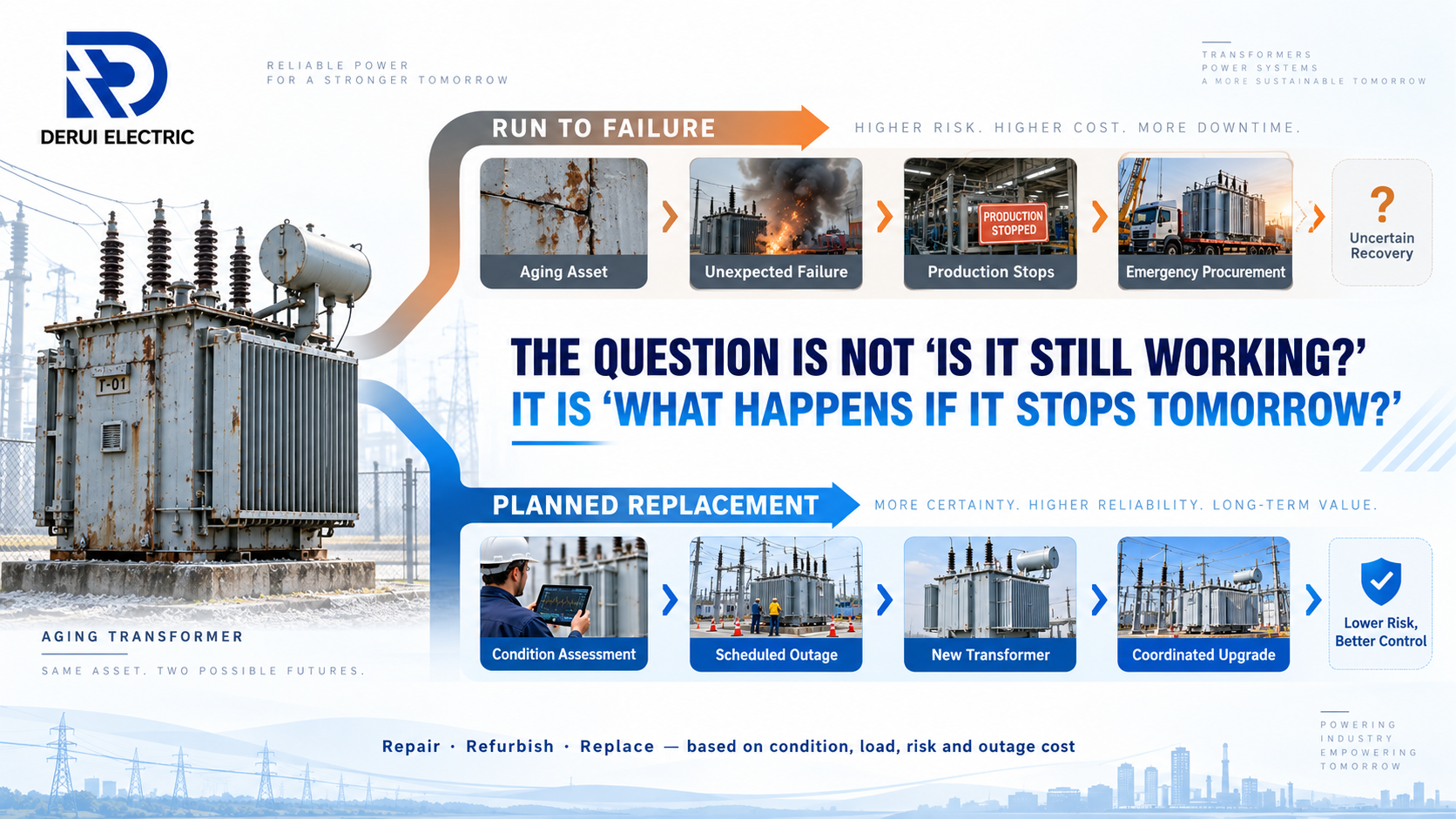
Transformer replacement decisions are usually based on condition, system needs and risk—not age alone.
Sometimes the Transformer Is Not “Bad” — the System Has Simply Moved On
A transformer installed 20 or 30 years ago may still operate correctly.
But the network around it may no longer look the same.
- Loads grow.
- Industrial areas expand.
- New feeders are added.
- Renewable generation changes power flows.
- Protection and monitoring technologies improve.
In those cases, replacement can become an opportunity to change more than the transformer itself.
Planned replacement may allow operators to reconsider equipment configuration, spare-unit strategy, location, monitoring capabilities and protection architecture rather than simply installing an identical new unit in the same place.
Waiting for Failure Can Be the Most Expensive Option
There is an obvious temptation:
If the transformer still works, why spend money replacing it?
Because the cost of the transformer itself may not be the largest cost created by its failure.
For an industrial plant, an unexpected transformer outage can mean:
Planned replacement changes the economics.
Equipment can be specified in advance. Shutdown windows can be scheduled. Switchgear and protection upgrades can be coordinated at the same time. Spare capacity and alternative feeds can be considered before the old unit is removed.
The objective is not to replace equipment simply because it is old. Replacement becomes reasonable when the risk and cost of keeping the asset becomes greater than the value of postponing the investment.
Brazil’s 312 Replacements Are Part of a Bigger Pattern
ISA ENERGIA BRASIL’s latest program is not an isolated quarter.
In 2025, the company invested R$1.69 billion in reinforcement and improvement projects and replaced more than 2,000 pieces of equipment, including transformers, breakers, disconnectors and protection systems.
That points to a broader question increasingly facing utilities and industrial operators:
AND
Transformer Replacement Is a System Decision
For industrial and EPC projects, replacing a transformer is not only about matching the old kVA rating. Voltage level, load growth, future expansion, impedance, switchgear configuration, installation environment and protection requirements may all need to be reviewed at the same time.
Derui Electric manufactures oil-immersed and dry-type transformers together with MV/LV switchgear for overseas industrial and EPC projects, supporting equipment selection based on actual project conditions.
The Best Time to Replace a Transformer Is Not Always After It Fails
Age matters, but age alone does not determine whether a transformer should stay in service.
Condition, loading, maintenance history, replacement lead time and the operational cost of failure all matter.
The practical question is simple: if this transformer becomes unavailable tomorrow, how much would it cost—and how long would replacement take?
Frequently Asked Questions
When should a power transformer be replaced?
Replacement should be based on condition, loading, maintenance history, reliability risk, spare availability and the cost of an unplanned outage—not on age alone.
Is it better to repair, refurbish or replace an aging transformer?
The answer depends on equipment condition, remaining life, repair cost, future load requirements and how critical the transformer is to the electrical system.
Why replace a transformer before it fails?
Planned replacement allows equipment procurement, shutdown scheduling and protection or switchgear upgrades to be coordinated before a failure creates emergency downtime.
Should switchgear be reviewed during transformer replacement?
Yes. A transformer replacement can change current levels, protection settings, future capacity and operating requirements, so associated MV/LV switchgear and protection should be reviewed as part of the project.
Planning a Transformer Replacement or Substation Upgrade?
Share your existing transformer rating, voltage level, load profile, installation environment and future expansion requirements. Derui Electric can support transformer and MV/LV switchgear selection for overseas industrial and EPC projects.
Contact Derui ElectricSources
- ISA ENERGIA BRASIL: R$815.4 million invested in transmission-grid modernization in H1 2026
- ISA ENERGIA BRASIL: 2025 reinforcement and improvement investment results
- EPRI: Planned large power transformer replacement guidance
- Bonneville Power Administration: Utility distribution system improvement measures