











19 Minutes the First Time. Seven Hours the Second. What Happened to Mexico’s Power Corridor?
19 Minutes the First Time. Seven Hours the Second. What Happened to Mexico’s Power Corridor?
The same 400 kV transmission corridor went down twice in less than three months. The second outage affected more than 745,000 customers.
On June 3, two 400 kV transmission lines in southeastern Mexico suddenly went offline.
The grid reacted almost immediately.
An automatic load-shedding scheme disconnected 579 MW of demand and interrupted another 54 MW being exported to Belize.
According to Mexico’s grid operator CENACE, the protection scheme prevented a much larger 2,234 MW disturbance across Campeche, Yucatán and Quintana Roo.
Nineteen minutes later, the affected load was back.
It looked like a successful demonstration of what grid protection is supposed to do.
Then, less than three months later, it happened again.
Same Corridor. Very Different Night.
On August 31, the Escárcega–Ticul 400 kV corridor went down again.
This time, the lights did not return in 19 minutes.
The blackout stretched for more than seven hours, affecting 745,533 customers and 171 medium-voltage circuits across Yucatán, Quintana Roo, Campeche and Chiapas.
In Mérida, the consequences quickly moved beyond “the lights are off.”
Traffic signals stopped working.
Some mobile and internet services were disrupted.
Parts of southern Yucatán reported water-supply interruptions.
Temperatures in Mérida had approached 40°C.
Then businesses started counting the cost.
Local business groups in Mérida gave a preliminary estimate of up to MXN 100 million in losses, particularly for restaurants and other businesses dependent on evening trade.
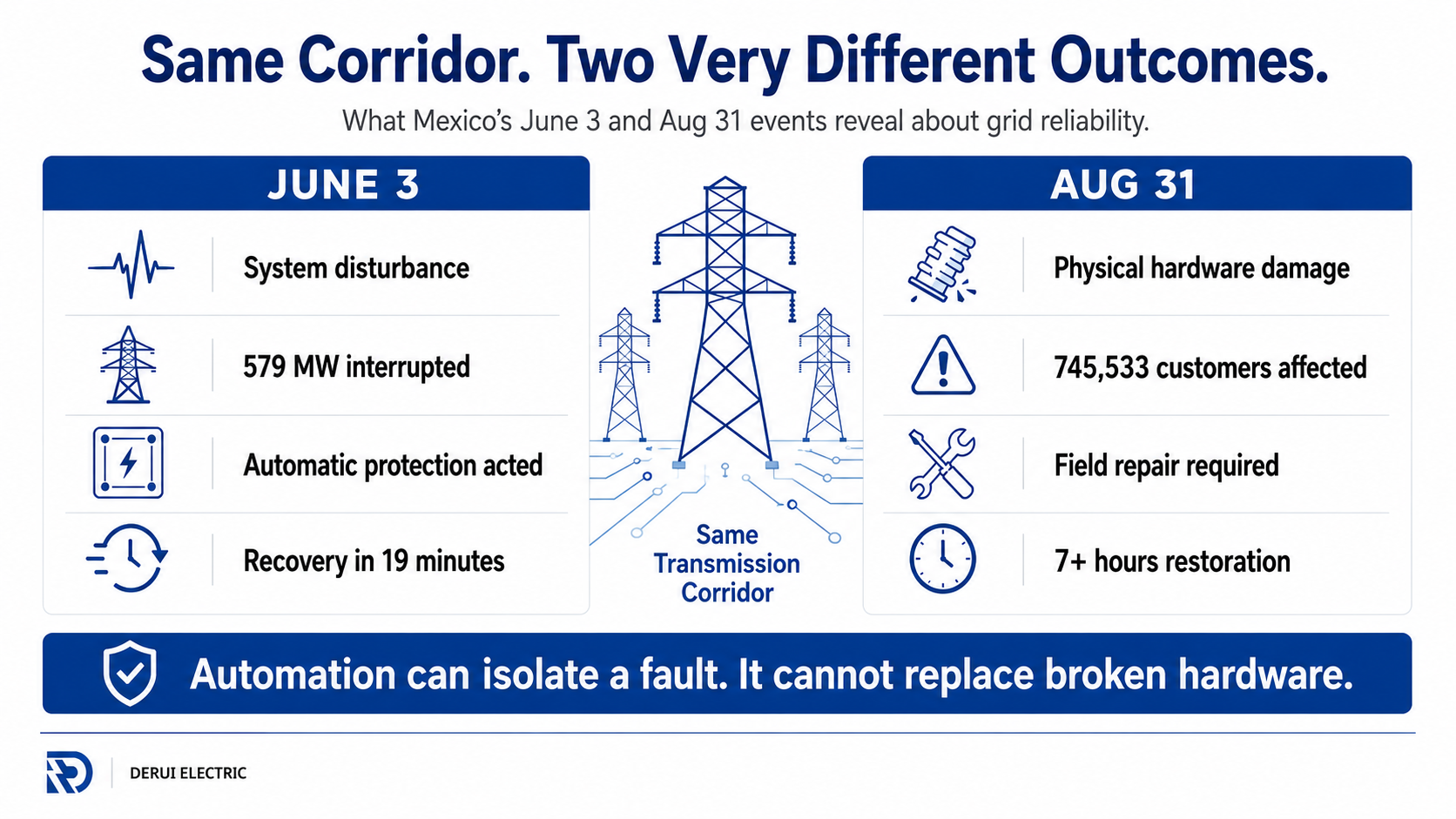
The same transmission corridor experienced two major incidents less than three months apart—but the recovery time was dramatically different.
The First Time, Automation Bought Time
In June, the automatic protection system did what engineers design these systems to do:
But August brought another problem.
CFE later reported targeted physical damage to insulator discs and both 400 kV lines. It said the damage pattern was similar to incidents previously recorded on the same corridor.
That distinction matters.
Software can switch a circuit.
Protection can isolate a fault.
Automation can prevent a bad event from becoming a much worse one.
But software cannot physically replace a damaged insulator.
Maybe the Most Important Number Is Not 745,533
It is two.
Two incidents.
Same transmission corridor.
Less than three months apart.
That changes the story from:
↓
The Same Question Exists Inside a Factory
A national transmission corridor and an industrial power system are obviously very different in scale.
But a factory may still depend on one critical path:
Those components may operate reliably for years.
But reliability statistics do not answer the most important question:
What happens to production on the day that one critical component is unavailable?
The Cost Starts After the Lights Go Out
The Mexican blackout lasted only hours.
But during those hours, electricity disappeared first.
Then traffic control.
Communications.
Water supply in some areas.
And business revenue.
Sometimes the real cost of a power failure begins after the lights go out.
Planning Around Critical Power Paths
For industrial and EPC projects, transformer capacity is only one part of the reliability question. Incoming supply arrangement, switchgear configuration, bus sectionalization and backup strategy can all influence what happens when one critical component becomes unavailable.
Discuss Your Project with Derui Electric →