










Nepal Lost 10% of Its Power Capacity in One Flood. What Does That Mean for Hydropower Planning?
Nepal Lost 10% of Its Power Capacity in One Flood. What Does That Mean for Hydropower Planning?
A catastrophic flood affected 431 MW of generation capacity and forced a country built around hydropower exports to begin importing electricity.
The human impact of the disaster remains the most important concern. Search and recovery operations have continued across affected Himalayan communities, while damage to hydropower infrastructure represents only one part of a much wider tragedy.
Nepal’s latest flood disaster has exposed how quickly an energy system built around one natural resource can become vulnerable when the environment itself changes.
Nepal’s Energy Ministry says approximately 431 MW of generation capacity was affected—around 10% of the country’s total.
Nepal, which normally exports electricity to neighbouring markets, has halted exports and expects to import power from India while damaged facilities are assessed and restored.
For a country where hydropower provides almost all electricity, losing one tenth of generation capacity at once becomes a national energy-security problem.
From Power Exporter to Power Importer
Nepal has spent years expanding hydropower not only to meet domestic electricity demand, but also to turn electricity into an export industry.
Hydropower exports have grown rapidly over the past decade and have become an increasingly important part of the country’s external trade.
Nepal also plans to expand hydropower capacity substantially over the coming decade, with neighbouring India expected to remain an important market for future electricity exports.
But concentrating such a large share of national electricity production in one technology—and in vulnerable mountain river systems—also creates concentration risk.
The Problem Is Bigger Than a Dam
The floods affected 11 hydropower projects that were either operating or under construction.
That is an important reminder that hydropower resilience cannot be judged only by whether a dam or turbine survives extreme water conditions.
A complete hydropower system may include:
Floods, landslides and debris can damage different parts of that chain.
Even if generating equipment itself remains mechanically intact, damaged roads, substations, transmission lines or supporting infrastructure can still prevent electricity from reaching the grid.
Can Historical Hydrology Still Predict Future Risk?
This may be the most important long-term infrastructure question raised by the disaster.
Hydropower projects are traditionally designed using historical information: river flows, rainfall records, flood levels, glacier behaviour and previous extreme events.
But as climatic and mountain conditions change, past observations may become less reliable as a guide to future risk.
If tomorrow’s extreme conditions no longer resemble yesterday’s, historical design assumptions may no longer provide the same safety margin.
This is particularly important for infrastructure expected to operate for 30, 40 or even 50 years.
Transformers, substations, transmission lines and hydropower structures installed today may still be operating decades from now—under environmental conditions different from those used when the project was originally designed.
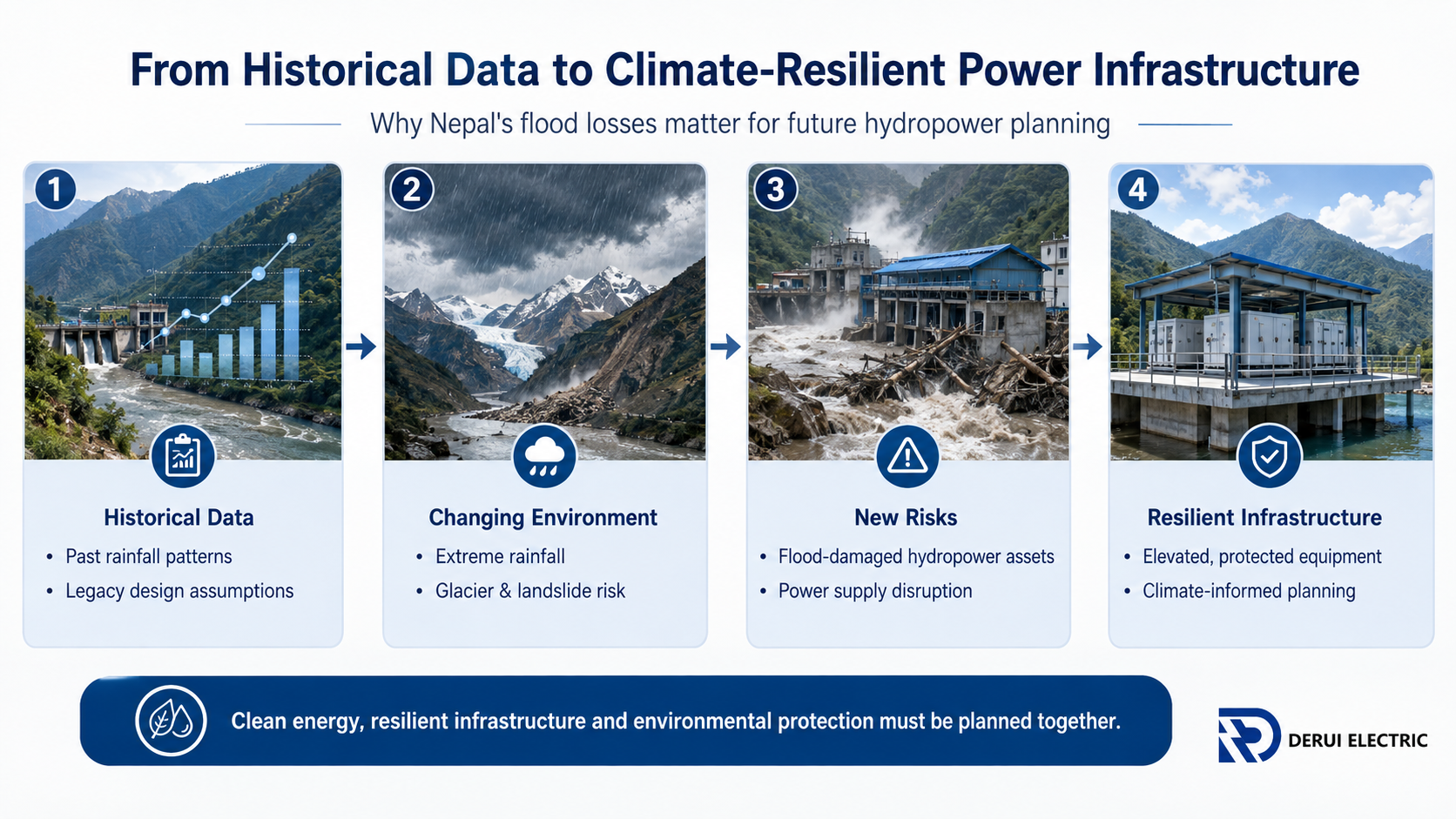
Long-life power infrastructure increasingly needs to account for environmental conditions that may differ from historical records.
Some Events May Exceed What Engineering Can Prevent
There is also an important limit to the discussion about resilience.
Not every natural disaster can be prevented simply by building stronger equipment.
Extreme mountain events can involve a combination of ice, rock, water, mud and debris moving with enormous force through narrow valleys.
In such situations, even well-designed infrastructure can be overwhelmed.
The objective therefore has to be more realistic:
For substations and distribution systems in flood-prone areas, this may involve equipment elevation, drainage design, cable routing, access planning, protection systems, redundancy and the placement of critical control equipment.
Clean Energy Still Depends on a Stable Environment
Hydropower is often discussed as part of the solution to climate change.
In Nepal, it provides almost all of the country’s electricity and supports a growing clean-energy export industry.
But the disaster reveals a difficult paradox.
Clean-energy infrastructure still depends on a stable natural environment.
A hydropower plant may produce low-carbon electricity for decades, but its dams, tunnels, substations, transformers and transmission lines are still exposed to rivers, glaciers, mountains and weather systems that are changing around them.
Protecting the climate and protecting power infrastructure are therefore becoming increasingly connected goals.
Reducing greenhouse-gas emissions can help limit the long-term warming that contributes to glacier retreat and mountain instability.
At the same time, infrastructure being built today has to prepare for a climate that may already be different from the one described by historical records.
A Wider Lesson for Power Infrastructure
Nepal is an extreme case because of its geography and dependence on hydropower.
But the engineering question extends far beyond the Himalayas.
Industrial parks, substations, renewable-energy projects and distribution systems are often designed using assumptions about:
- Flood levels
- Ambient temperature
- Rainfall
- Wind conditions
- Drainage
- Soil conditions
- Equipment accessibility
These assumptions can remain embedded in an electrical project for decades.
That is why environmental conditions should not be treated as secondary details during equipment specification.
Environmental Conditions Are Part of Equipment Selection
For overseas industrial and EPC projects, transformer and switchgear selection should consider not only electrical ratings, but also installation altitude, temperature, humidity, flooding risk, enclosure requirements and maintenance conditions.
Derui Electric manufactures transformers, MV and LV switchgear and related distribution equipment for overseas projects, with equipment configuration based on voltage level, load requirements and the actual operating environment.
Clean Energy, Resilience and Environmental Protection Cannot Be Planned Separately
The lesson from Nepal is not that hydropower should be abandoned.
It is that clean energy, resilient infrastructure and environmental protection increasingly have to be planned together.
The power system of the future has to do more than generate low-carbon electricity.
It also has to survive the environmental changes that a warming world is already bringing.
Frequently Asked Questions
How much of Nepal’s power capacity was affected by the floods?
Nepal’s Energy Ministry reported around 431 MW of affected generation capacity, equivalent to approximately 10% of the national total.
Why is Nepal particularly vulnerable to hydropower disruption?
Nepal depends heavily on hydropower, while many projects are located in steep Himalayan river systems exposed to floods, landslides, glacial hazards and difficult access conditions.
Can historical flood data still be used to design future power infrastructure?
Historical data remains important, but long-life infrastructure may increasingly need additional climate-risk scenarios because future environmental conditions may differ from past patterns.
What does climate-resilient electrical infrastructure mean?
It can include appropriate equipment elevation, drainage, enclosure protection, redundancy, monitoring, access planning and equipment selection based on realistic environmental conditions over the project lifecycle.
Planning Electrical Equipment for Challenging Environments?
Share your voltage level, transformer capacity, installation altitude, temperature, humidity, enclosure requirements and project environment. Derui Electric can support transformer and MV/LV switchgear selection for overseas industrial and EPC projects.
Contact Derui Electric