



One CT and Breaker Exploded. Then 310,000 Customers, a Metro Line and 1,500 Industries Lost Power.
One CT and Breaker Exploded. Then 310,000 Customers, a Metro Line and 1,500 Industries Lost Power.
A failure at Pune’s Chinchwad 220 kV substation spread far beyond one equipment bay—and different customers experienced very different recovery times.
At around 12:25 p.m. on September 6, an explosion tore through a 220 kV extra-high-voltage substation in Chinchwad, near Pune, India.
Officials said the incident involved a 22 kV current transformer (CT) and circuit breaker. The explosion triggered a fire and forced operators to isolate the affected section.
Within minutes, the problem had moved far beyond one equipment bay.
Some local users continued to report extended power problems after the initial restoration. One residential complex told local media it used about 260 litres of diesel—costing roughly ₹22,000—during around 24 hours of backup-generator operation. This was an individual customer case, not a region-wide outage duration.
What Happened at the Chinchwad 220 kV Substation?
The reported explosion involved a current transformer and circuit breaker at the Chinchwad substation.
Around 310,000 consumers across Pimpri-Chinchwad, Bhosari and parts of Pune lost electricity.
Pune Metro’s PCMC–Swargate service was disrupted for about 25 minutes.
In the Ambethan industrial area, roughly 1,500 industrial consumers were affected before supply was restored later that afternoon.
One equipment failure had suddenly become a city-scale power event.
What Is a Current Transformer (CT)?
A current transformer is not the same thing as a main power transformer.
A current transformer, or CT, is an instrument transformer that converts high primary current into a lower, standardized current that meters and protection relays can safely measure.
In a substation, CTs provide critical information to metering and protection systems.
That means a CT may be much smaller than the main power transformer, but its role inside the protection chain is still important.
Why Can a CT and Circuit Breaker Failure Cause a Large Outage?
A substation is not one large piece of equipment.
It is a chain of electrical and protection functions:
If one critical section must be isolated, downstream equipment may be perfectly healthy and the load can still lose supply.
That is why the more useful question is not simply, “Which device failed?” It is, “How much of the system depends on that point?”
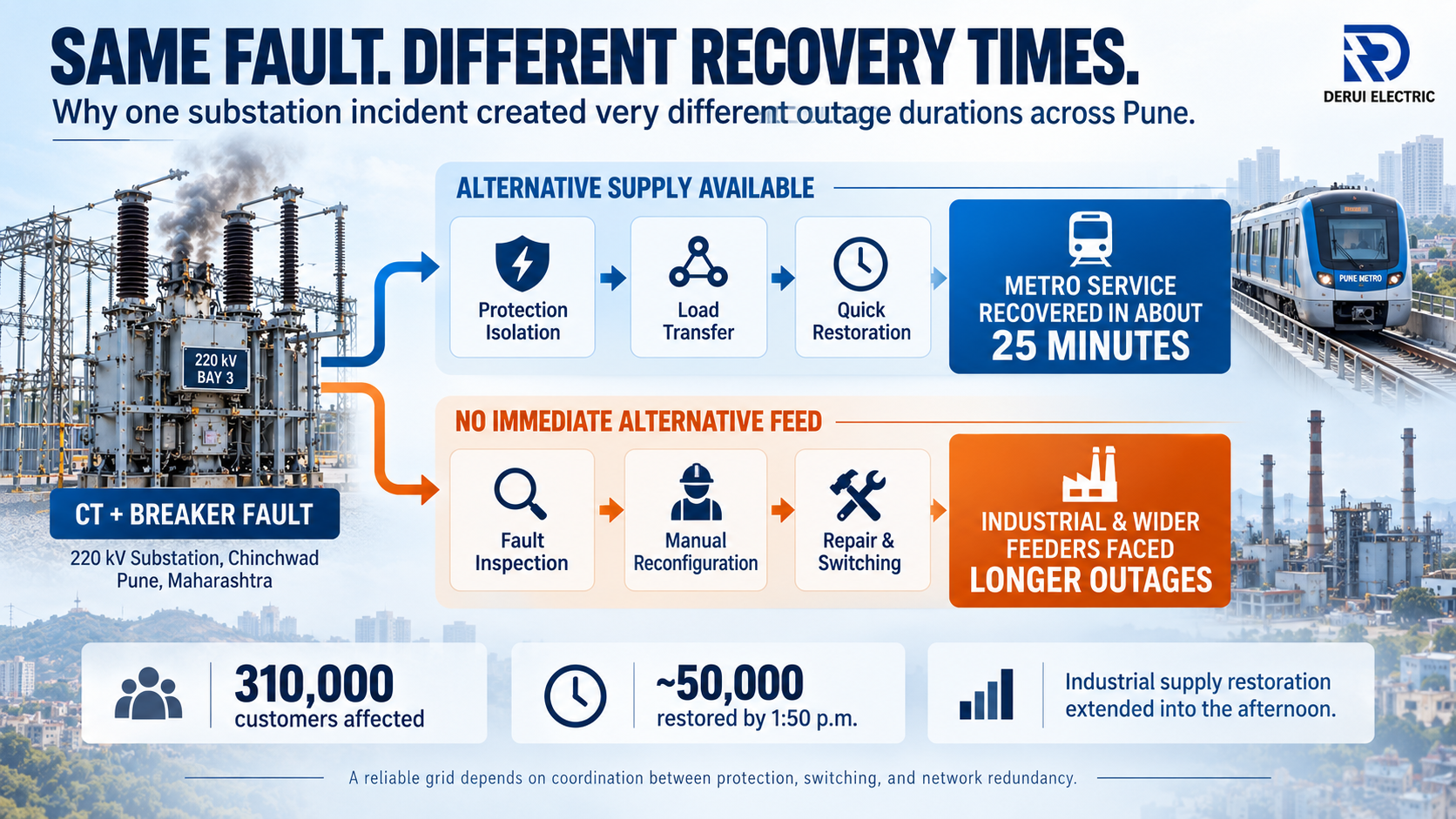
The same upstream failure can produce very different outage durations depending on alternative supply paths and switching options.
How Alternative Power Supply Changed the Recovery Time
The blackout did not end everywhere at the same time.
Around 50,000 consumers in parts of Pune were largely restored by about 1:50 p.m. through alternative supply arrangements.
Most affected areas were back by around 3 p.m.
But at that point, roughly 125,000 consumers in areas including Nigdi, Ravet, Wakad and Dehu Road were still awaiting restoration.
The Ambethan substation serving major industrial loads was restored at around 4:20 p.m.
Alternative feed → switching → shorter interruption
Single supply path → repair required → longer downtime
A Metro Can Switch Supply. A Factory May Not Be Able To.
Pune Metro resumed service after an alternative power source was arranged.
Talegaon town was also supplied through an alternative line from Khopoli, although officials said industrial supply faced technical limitations.
That contrast is more useful than simply saying “grid resilience matters.”
Two customers experiencing the same upstream failure may face completely different consequences depending on how their electrical systems are configured.
For a factory, the difference between a short electrical interruption and hours of lost production may simply be whether another power path exists.
What Industrial Power Systems Can Learn from the Pune Outage
Industrial buyers often focus heavily on the main transformer.
That makes sense—it is one of the largest and most valuable pieces of equipment in many substations.
But transformer capacity alone does not define system reliability.
CTs, protection relays, breakers, switchgear, bus sections and incoming feeds all influence what happens after a fault.
For industrial and EPC projects, the practical question is therefore not only:
↓
Reliability Is a System-Level Decision
For industrial and EPC projects, transformer selection should be coordinated with MV/LV switchgear, protection, incoming supply arrangement and future expansion requirements rather than treated as an isolated equipment decision.
Derui Electric manufactures transformers and MV/LV switchgear for overseas industrial and EPC projects, supporting equipment configuration based on voltage level, load requirements and project operating conditions.
A Reliable System Is Designed for the Day Something Goes Wrong
The Chinchwad incident affected hundreds of thousands of customers, a metro line and major industrial loads.
Most industrial substations operate at a much smaller scale.
But the principle is the same: a power system is not reliable because every component is perfect. It is reliable because the system knows what to do when one of them is not.
Frequently Asked Questions
What is a current transformer in a substation?
A current transformer, or CT, is an instrument transformer that converts high primary current into a lower standardized current for metering and protection relays.
What happens when a current transformer fails?
The consequence depends on the failure mode and system design. A CT fault can require the affected section to be isolated and may interrupt downstream supply until the fault is cleared or an alternative supply path is available.
Can circuit breaker failure cause a substation outage?
Yes. Circuit breakers are responsible for interrupting fault current and isolating electrical sections. A breaker-related failure can affect supply depending on the substation layout, protection scheme and available redundancy.
Why do industrial plants need alternative power supply paths?
An alternative feed, sectionalized bus arrangement or backup source can reduce downtime when a transformer, breaker, feeder or other critical component becomes unavailable.
Planning an Industrial Power Distribution System?
Share your voltage level, transformer capacity, load profile, switchgear requirements and redundancy strategy. Derui Electric can support transformer and MV/LV switchgear selection for overseas industrial and EPC projects.
Contact Derui ElectricSources
- The Indian Express: Chinchwad substation fire and power restoration
- India Today: Pune power outage and alternative supply arrangements
- Times of India: Post-outage backup generation impact